A recent survey by MGMA finds practices that beef up their office staff, even to as many as four support staff per physician, can see an income boost from it.
This week’s Part B News covers the finding from a new report from The Medical Group Management Association (MGMA), the 2017 MGMA DataDive Cost and Revenue Survey, that “practices with a higher non-physician provider (NPP) to physician ratio (0.41 or more NPPs per full-time equivalent [FTE] physician) earn more in revenue after operating cost than practices with fewer NPPs (0.20 or fewer NPPs per FTE physician) regardless of specialty.”
That survey also finds it pays to beef up general support staff – from administrative staff such as receptionists to non-NPP clinical staff such as registered nurses and phlebotomists.
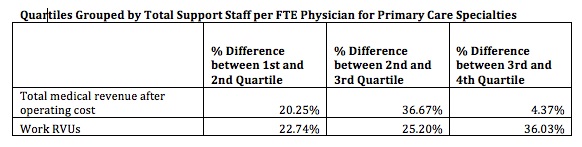
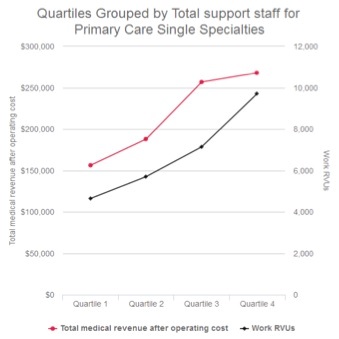
Broken into quartiles, with practices utilizing 2.7 or fewer support staff per FTE provider in the first quartile and those using 5 or more in the fourth, MGMA found the third quartile – about four support staff per FTE provider – is a “very clear sweet spot” for profitability, says Dave Gans, Senior Fellow Industry Affairs for MGMA in Englewood, Colo.
But when you get to five staff per FTE, Gans says, “staff costs go up considerably - and they also need more space to work,” cutting into profitability. But while the profitability gain slows down in the fouth quartile, productivity in terms of RVUs keeps climbing. See the charts below:
"Staffing is an investment in the practice,” says Gans. “The critical resource is doctor time. By having additional staff, you can get more work from the doctor. If a [primary care provider] has four exam rooms, you want the doctor to move easily from one room to another and focus on the needs of his or her patient. That’s why you have scribes – so [doctors] aren’t turning around and entering info.”
Gans relates this to the “Lean Six Sigma” approach to process complexity, whereby efficiencies are gained by removing unnecessary steps in a process. He also thinks practices that are really interested in efficiency should look at the physical design of their offices as well. “If the practice is a newer facility, designed around workflow, versus one with a more traditional design, you can gain efficiencies,” he observes. “…if you gain two or three minutes per patient, that’s one patient a day gained."
See more about the 2017 MGMA DataDive Cost and Revenue Survey here.